
Dark spots: peel, photorejuvenation or HydraFacial — how we choose
Three treatments for spotty, uneven skin, three different approaches. What sets them apart, and what we look at to choose.
“I've got dark spots — what should I do?” The question tends to come up at the end of summer, when the tan fades and the marks stay put. And on our page about pigmentation, three treatments sit side by side: photorejuvenation, the TCA chemical peel and HydraFacial®. It's easy to get lost.
They aren't three versions of the same treatment, or three rungs on the same ladder. Each works in its own way. Here's what sets them apart, and how we choose with you.
First, where your spots come from
Not all spots are alike. The causes we see most often are sun exposure, hormonal factors, and marks left behind by inflammation — a blemish, for instance, that healed but left a darker trace. What we suggest depends partly on that origin, and on the nature of the spot.
That's also why the first step isn't a treatment but an assessment. It's there to match the intensity to your skin, and to rule out situations that call for medical advice rather than an aesthetic treatment. A spot that worries you should be shown to a doctor; it isn't an aesthetic clinic's place to judge it.
Photorejuvenation: the light targets colour
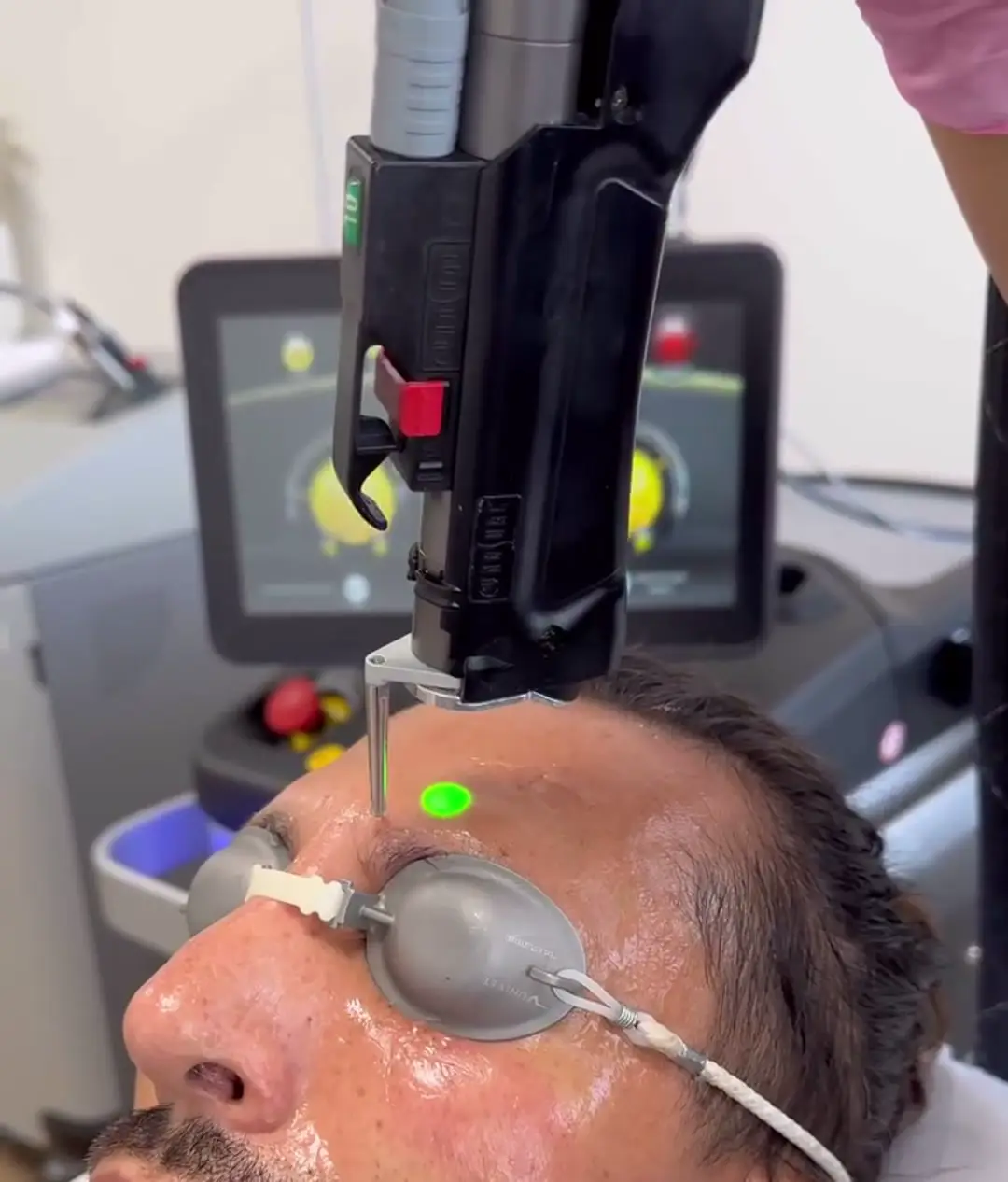
Photorejuvenation works through light from the Elite iQ™ laser, set for your skin after the assessment. That light targets colour irregularities selectively rather than the skin as a whole. That's what sets it apart: it doesn't exfoliate, it aims at what's darker. The treatment page lists it for uneven tone, diffuse redness and small spots.
Day to day, mild redness may show up after the session and usually fades within a few hours. The real constraint lies elsewhere: the sun. You need to avoid it before and after, and tanned skin means the session gets pushed back rather than done anyway. Some skin tones and some conditions also call for extra caution with light — which is exactly what the assessment checks.
The TCA peel: renewing the surface
The chemical peel has no device at all. A solution is applied in a controlled way to exfoliate the skin's surface layers. Concentration and contact time are adjusted to your skin and your goal, and we start cautiously rather than strong. Its treatment page lists it for dull skin, dark spots, uneven texture and acne-prone skin.
The trade-off is what follows the session: redness and flaking are possible depending on intensity. We tell you what to expect before setting the date, so it doesn't land the day before an event. And after a peel, sun protection is essential. Peels are often done as a course of several sessions, for a gradual result.
HydraFacial: radiance, not the spot itself
Let's be straightforward about this third one. HydraFacial® runs through cleansing and gentle exfoliation, pinch-free extraction, then serum infusion. Its treatment page lists it for dull skin, dehydration, congested pores and uneven texture. It doesn't mention spots, and we won't tell you it makes them disappear.
So why is it on the list? Because spotty skin is often dull skin too, and some people are looking for radiance first, with no downtime, before considering anything else. The treatment generally involves no downtime and suits most skin types. It's an honest way in, not a treatment for spots.
How we decide at the consultation
No treatment is “better” than the others. There's the one that fits your skin, what bothers you, and what your calendar allows. Here's what we look at:
- The nature of the spots and their likely origin: sun, hormonal factors, marks left by inflammation.
- What bothers you most: a few specific spots, uneven tone with redness, or dullness overall.
- Your skin tone and skin type, which decide how cautious to be with light and how strong a peel should be.
- The season and your sun exposure: tanned skin pushes a photorejuvenation session back.
- Your calendar: a few hours of redness don't weigh the same as a few days of flaking.
Sometimes the answer is “not now”, or “a different treatment”. We tell you so, rather than sell you a session that isn't right for you.
If you're torn between these three treatments, that's exactly what a consultation at the clinic in Ahuntsic is for: looking at your spots, ruling out anything that needs medical advice, and telling you honestly which one makes sense for you, and at what time of year. The photorejuvenation page details the session and the precautions; the price is on the Prices page.
This article explains a treatment in general terms. It does not replace a consultation: what suits your skin is decided with you, at the clinic. Results vary from person to person.