
TCA peel or Hydrafacial: two treatments, two goals
Both aim for fresher-looking skin, but not in the same way or at the same pace. How to tell which one answers what you're after.
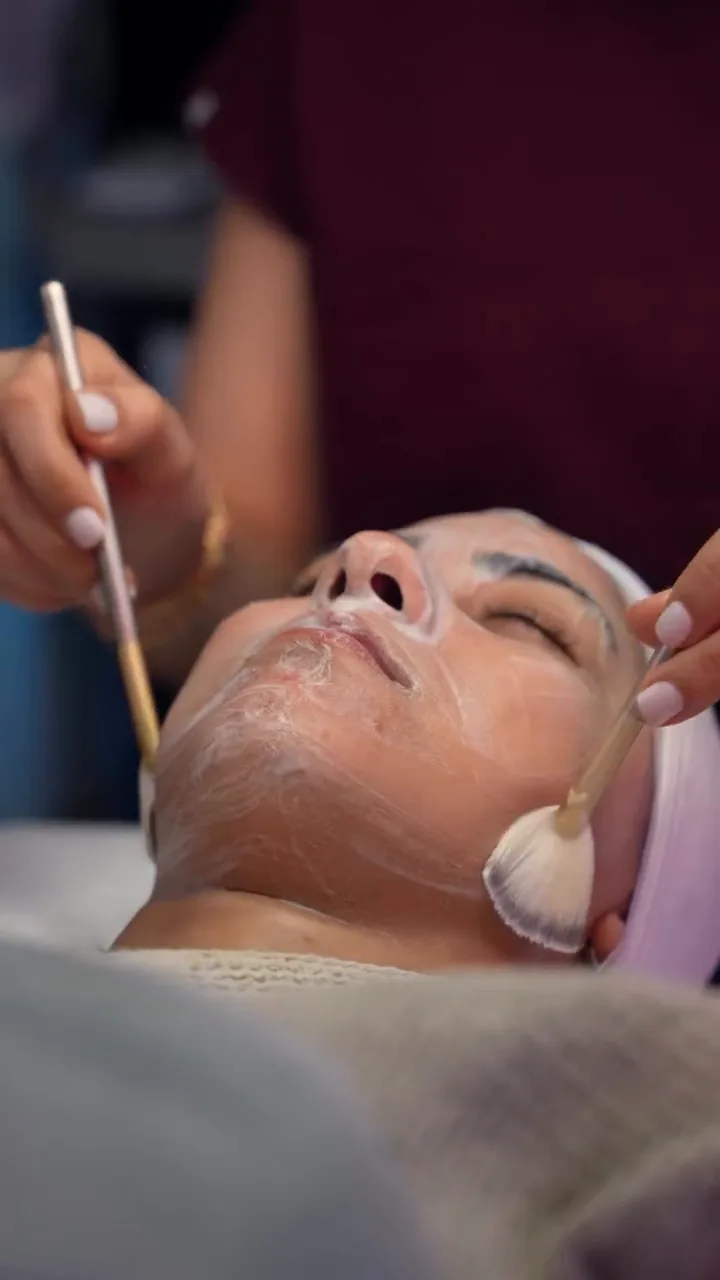
“I want my glow back: should I get a peel or a Hydrafacial?” It's one of the questions we hear most often, and it's a fair one. On paper, the two treatments look alike: they're done on the face, they both talk about dull skin and texture, and they take roughly the same amount of time. In practice, they don't answer the same need, they don't ask the same thing of you after the session, and they don't fit into the same calendar.
Here's how we tell them apart at the clinic, and how we decide with you.
Hydrafacial: cleanse, decongest, hydrate
Hydrafacial® is a complete facial, done with a tip under suction, in several steps. The skin is first cleansed and gently exfoliated. Then comes pinch-free extraction: the tip draws out what's clogging the pores instead of squeezing the skin between two fingers. The protocol ends with an infusion of hydrating serums chosen for your skin. Plan for about 60 minutes.
What sets it apart is its immediate effect and its lack of aftermath: you leave with brighter, more hydrated skin, and there's generally no downtime — you go back to your day on the way out. That's why people book it before an event, or as regular maintenance. It suits most skin types, and it addresses a dull complexion, dehydrated skin, congested pores, uneven texture and signs of fatigue.
The TCA peel: renewing the surface, at your pace
A TCA peel, or trichloroacetic acid peel, works differently. There's no device: an exfoliating solution is applied by hand, in controlled passes, to the area being treated, then neutralized. It exfoliates the skin's surface layers. Concentration and contact time are chosen with you after an assessment, and the principle is to start cautiously rather than strong. The session takes about 45 to 60 minutes.
What it aims for is fresher, more even skin and a refined texture, over the sessions. It comes into the conversation when the topic is dark spots, uneven texture, or the marks left behind by acne-prone skin that has since settled. The result is gradual: a peel is often done as a course of several sessions, and the plan is set with you, never sold upfront.
It also has an aftermath. Redness and flaking are possible, depending on the intensity chosen, and sun protection is essential after the session. Written instructions are handed to you before you leave.
The real difference: immediate or gradual
The two treatments share a vocabulary — glow, dull skin, texture — and that's where the confusion comes from. But they don't work on the same part of the problem. Hydrafacial deals with what's clogging and what's missing: blocked pores, dehydrated skin that feels tight and that makeup doesn't sit well on. A peel renews the surface itself, which is why it comes up for dark spots or marks rather than for skin that's simply tired.
The second difference is time. One shows as you walk out and leaves you nothing to manage; the other builds up session after session and asks for a few precautions in the days that follow. Neither is “better”: they don't answer the same question. And in both cases, results vary from person to person and are not guaranteed.
How we decide: your goal, then your calendar
The first question isn't “which treatment?” but “what's bothering you?” A few pointers, meant to prepare the conversation, not replace it:
- An event is coming up and you want glowing skin with nothing to hide on the day: that's Hydrafacial territory, generally with no downtime.
- Your skin feels tight, your pores are congested, your products no longer seem to do anything: that's exactly what Hydrafacial addresses.
- Dark spots, uneven texture or acne marks that stayed behind: that's where a TCA peel enters the discussion.
- You can live with possible redness or flaking in the days that follow, and keep up with sun protection: the condition for considering a peel with peace of mind.
Your calendar matters as much as your goal. For a peel, we tell you what to expect before setting the date, precisely so it doesn't land the day before an event. And if an appointment needs to be postponed rather than done under the wrong conditions, we'd rather postpone.
What the consultation looks at
We look at the state of your skin, what bothers you, your treatment history and what you're applying right now. For a peel, the assessment is also what sets the type and intensity, and what checks that the treatment suits you. Sensitive skin isn't ruled out by default: the intensity is adapted, and that's exactly what the assessment is there to determine. If neither treatment is right for you, we tell you — and we tell you which one is.
If you're torn between the two, that's exactly the kind of question the consultation at the clinic in Ahuntsic is there to settle: we look at your skin, tell you honestly which one fits your goal, and choose the timing with you. The TCA peel page details the protocol, the duration and the instructions, and the Hydrafacial page describes each of its steps; the price is on the Prices page.
This article explains a treatment in general terms. It does not replace a consultation: what suits your skin is decided with you, at the clinic. Results vary from person to person.