
Laser hair removal on dark or tanned skin: what changes
Dark skin and tanned skin are not the same question. What the laser targets, what the patch test checks, why we postpone.
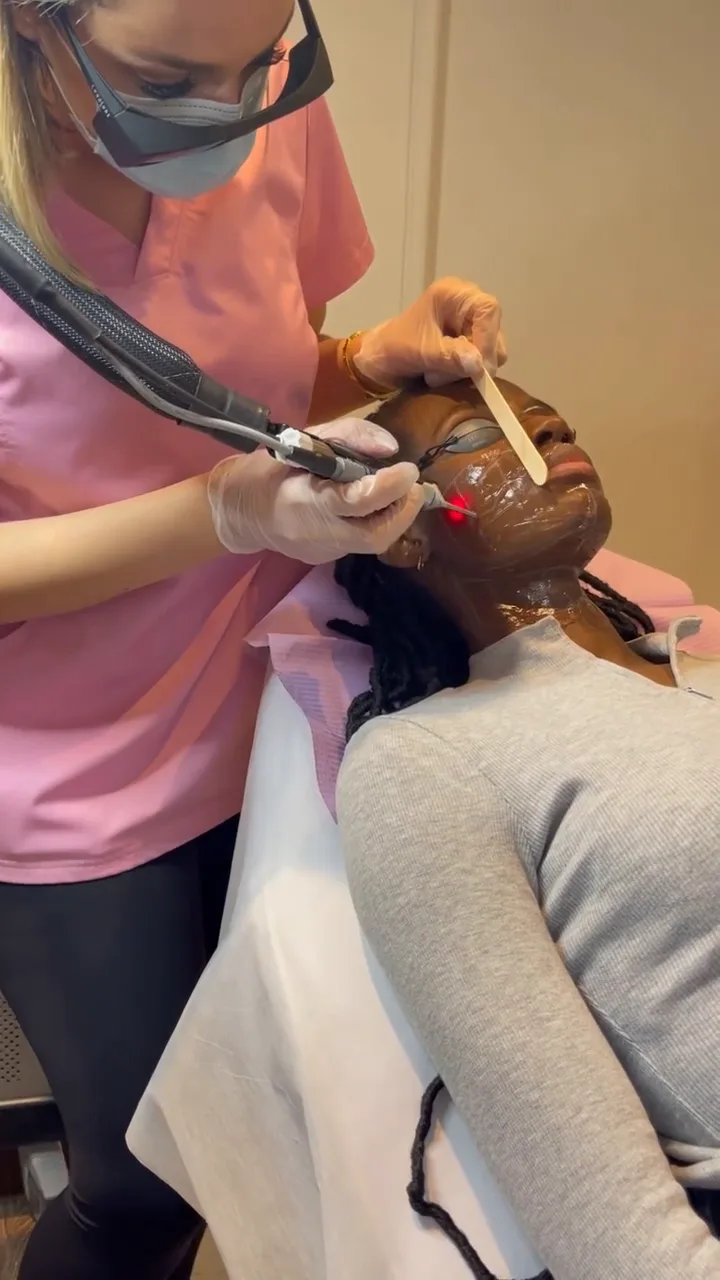
It's the question we get most often on the phone, and often with a note of wariness: “does laser work on skin like mine?” Behind that sentence there are really two very different questions that tend to get mixed together. Naturally dark skin is not tanned skin. The first is your complexion, the one you live with all year. The second is a passing state: skin that has just spent three weeks in the sun.
The two are handled differently, and only one of them is a reason to move an appointment. Here's what actually changes at SHAY Esthétique, in Ahuntsic, when you come in with either one.
What the laser targets, and why colour comes into it
The Elite iQ™ laser we use targets the melanin in the hair to slow regrowth. Melanin is the pigment that gives hair its colour — and, incidentally, gives skin its colour too. That's where the whole nuance of this article comes from: the device is looking for a pigmented target, and it needs to tell the difference between the hair it's aiming at and the skin around it.
It's also why one factor people rarely mention matters as much as skin tone: the colour of the hair itself. Some colours — very light or white hair in particular — limit how well the laser works, simply because there isn't much pigment left to aim at. If that's your situation, we'll say so straight at the consultation rather than sell you a course of sessions.
Dark skin: the settings change, not the treatment
The Elite iQ™ is a dual-wavelength laser. That isn't brochure trivia: it's exactly what allows different settings depending on your complexion and on how thick your hair is. Light skin with coarse hair and dark skin with fine hair are not worked the same way, and the device isn't meant to treat them the same.
On top of that, the handpiece has built-in cooling. The sensation stays brief and is generally well tolerated; it varies mostly by area, with the bikini line and underarms felt more than the legs. What we won't tell you is that you'll feel nothing: that would be a promise, and nobody can make it on your behalf.
The laser suits several skin types. But “several” isn't “all”, and a web page can't stand in for an assessment. That's what the next step is for.
The patch test: the only answer that applies to you
Before the first real session, a patch test confirms the setting suits your skin. A small area, one setting, and a look at how it responds. It's short, and it's the only step that truly answers the question at the top of this article — because it asks it of your skin, not of an average.
The assessment that goes with it serves the same purpose: to look at your hair, your skin type and the area you have in mind, and tell you honestly whether laser suits you. If the answer is no, you'll hear it. We prefer that to a package sold upfront for skin we've never seen.
Tanned skin: why we postpone rather than push ahead
Here the answer is simple and it isn't up for negotiation: sun exposure is avoided before and after the session, and if you arrive with recently tanned skin, we push the session back rather than go ahead. This isn't administrative rigidity — it's the same logic as above. A tan temporarily changes what the device sees, and a setting validated on your February skin is no longer the same setting on your July skin.
You leave your first appointment with precise, written instructions on what to avoid before and after. And if anything in your routine can colour your skin — a self-tanner, say — mention it: that's exactly the kind of detail that changes an instruction, and it takes you thirty seconds to tell us.
What it doesn't change: the rhythm of the sessions
Whatever your complexion, one thing stays the same: several spaced-out sessions are needed, because hair only responds during its growth phase. The exact number depends on your hair and the area. It's estimated with you at the consultation, never promised in advance, and hair reduction is progressive — it varies from person to person.
Between sessions you can shave any time. The wax, the tweezers and the epilator, however, go away for the whole course: those pull the hair out at the root, and then the laser has nothing left to target.
If someone has already told you “laser isn't for you” without looking at your skin, a second opinion was probably worth seeking. The consultation at the clinic is exactly that: we look at your hair and your complexion, we do the patch test, and we tell you what's reasonable to expect. You leave with a clear answer — even if it's no. Prices, area by area, are listed on the Prices page, and the treatment page details the device and how a session runs.
This article explains a treatment in general terms. It does not replace a consultation: what suits your skin is decided with you, at the clinic. Results vary from person to person.